
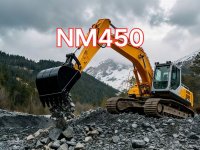

NM450 is a high-strength wear-resistant steel plate. Its designation follows the internationally recognized naming system for wear-resistant steels and primarily complies with the performance requirements specified in the European standard EN 13242:2022 "Aggregates for Unbound and Hydraulically Bound Mixtures for Construction Works – Specifications". It is also widely referenced against national industry standards, such as China's GB/T 24186-2019 "High-Strength Wear-Resistant Steel Plates for Construction Machinery". This standard clearly defines the chemical composition, mechanical properties, hardness, and testing methods for NM-series wear-resistant steels and serves as a widely accepted technical basis for production and trade globally. As a high-hardness grade within the wear-resistant steel family, NM450 delivers outstanding performance under extreme wear conditions and is a key material for replacing ordinary steel to significantly extend equipment service life.
The designation "NM450" has a clear meaning:
? ? "NM" stands for "Nai Mo", the pinyin abbreviation of the Chinese term for "Wear-Resistant". This naming convention is widely used in China and markets influenced by Chinese standards to identify high-strength low-alloy wear-resistant steels, distinguishing them from ordinary structural steels.
? ? "450" indicates the average Brinell hardness of the steel after quenching and tempering heat treatment is 450 HBW. According to relevant standards (e.g., EN ISO 6506-1), its actual hardness typically ranges from 420 to 480 HBW. This level is significantly higher than NM400 (370–430 HBW) and belongs to the high-wear-resistance category, effectively resisting extremely severe abrasive wear. While demanding higher requirements for toughness, weldability, and processability, it represents an advanced-grade wear-resistant steel that achieves an optimized balance between wear resistance and toughness.
The primary application of NM450 steel plate is in manufacturing critical components operating under extreme wear and high-impact conditions, especially where resistance to intense abrasive wear, high-stress impact wear, and gouging wear is required. Typical applications include:
? ? Mining and Quarry Equipment: High-wear areas of jaw crushers, cone crushers, and impact crushers, such as moving/fixed jaw plates, crushing mantles, concaves, and impact plates, which are in constant contact with hard rock and ore.
? ? Construction Machinery: Bucket teeth, front cutting edges, base plates, and side plates of large excavators and loaders—parts subjected to high impact and severe wear.
? ? Dump Trucks and Haulage Vehicles: Floor and side panels of heavy-duty mining trucks and dumper trucks transporting highly abrasive materials like iron ore, granite, and construction demolition debris.
? ? Cement and Building Materials Industry: Critical components such as rollers, mill liners, classifier rotors, and pipeline elbows in vertical mills, ball mills, and conveying systems exposed to high-speed particle erosion.
? ? Power and Metallurgical Industries: Coal chute pipes, raw coal bunkers, and ash hoppers in dust collectors—areas prone to severe wear.
Its main characteristics include:
? ? Extremely High Surface Hardness and Outstanding Wear Resistance: A hardness of 450 HBW provides exceptional resistance to abrasive wear, offering a service life far exceeding that of ordinary steel and medium-hardness wear-resistant steels, significantly reducing maintenance costs.
? ? Optimized Toughness and Impact Resistance: Through advanced alloy design and precise quenching & tempering processes, NM450 maintains sufficient toughness despite its ultra-high hardness, enabling it to withstand moderate-to-high impact loads and reducing the risk of cracking.
? ? Limited Weldability: Welding is challenging and must strictly follow welding procedures, including thorough preheating (typically 200–250°C), use of specialized wear-resistant filler materials, control of interpass temperature, and post-weld slow cooling to prevent cold cracking.
? ? Poor Cold Formability: Due to its extremely high hardness, cold forming capability is very limited. Only small-angle bends or large-radius bending are permitted, and cold working is generally not recommended.
? ? High Cost-Effectiveness (for Specific Applications): Although more expensive than NM400, its much longer service life in extreme wear conditions drastically reduces downtime and replacement frequency, resulting in significant overall economic benefits.
Therefore, NM450 is a high-performance, purpose-built wear-resistant steel, making it an ideal choice for combating the most severe wear challenges.

Ultrasonic Testing (UT)
A key non-destructive testing technique that uses high-frequency sound waves to detect internal flaws in steel plates. The probe emits sound waves, which reflect when encountering defects such as cracks or inclusions. The receiver captures the echoes, enabling precise determination of defect location and size. With high sensitivity, strong penetration, and fast inspection speed, UT effectively ensures internal quality, widely used in the production of heavy plates, pressure vessel plates, and other high-end products to guarantee safety and reliability.

Magnetic Particle Testing (MT)
A common surface inspection method that magnetizes the workpiece, causing leakage magnetic fields at surface or near-surface defects like cracks or inclusions, which attract magnetic particles to form visible indications. Simple to operate and highly sensitive, MT is suitable for rapid inspection of surface and near-surface flaws in ferromagnetic materials, widely used for online or offline inspection of plate edges, ends, and welds, ensuring product quality and safety.

Penetrant Testing (PT)
A non-destructive method for detecting surface-breaking flaws. A penetrant liquid is applied to the cleaned steel surface, allowing it to seep into defects such as cracks or pores. After removing excess penetrant, a developer is applied, causing the trapped penetrant to bleed out and form visible indications. Simple and cost-effective, PT is suitable for inspecting surface defects in various non-porous materials, commonly used for welds, castings, and complex components, effectively ensuring surface quality of steel plates.